How Automation Is Reshaping the Modern Workplace
Imagine a typical office from ten years ago: stacks of paper, spreadsheets shared via email, teams having to chase updates and approvals.
Now picture a modern workplace where many of those tasks happen automatically, systems talk to each other, and people focus on higher-level thinking rather than routine work.
Automation is no longer a buzzword. It is how many workplaces are adapting, growing, and staying competitive. In this post we will explore what workplace automation means, why it is happening, where it is having the greatest impact, the human side of automation, and what the future could hold.
What Is Workplace Automation?
Workplace automation refers to the use of technology to perform repetitive tasks that were once done manually. It does not always mean robots replacing humans. Instead it often means software or systems taking care of routine job functions.
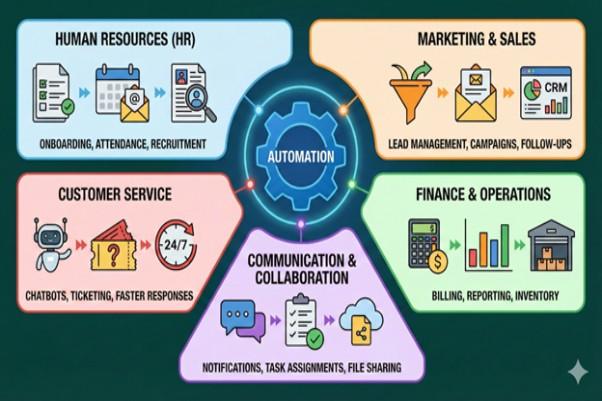
Automation can be applied in many parts of a business: human resources, finance, marketing, operations, customer support and more. Examples include: a system that tracks employee attendance and triggers payroll automatically, a chatbot that answers basic customer questions without a human agent, or project-management tools that send reminders and assign tasks when a milestone is reached.
These kinds of processes free up time for humans to focus on more strategic or creative work.
Why Businesses Are Turning to Automation
Several forces are pushing businesses to adopt automation. First, speed and efficiency are more important than ever. Customers expect fast responses and businesses must be agile. Second, the rise of remote and hybrid work models means teams are distributed, so tasks need to be managed and tracked in flexible ways.
Third, there is pressure to lower operational costs while increasing output and quality. Fourth, technology has become accessible: cloud platforms, APIs, no-code tools and advanced software make automation easier to implement than before. Because of these trends, automation is moving from optional to essential for many organisations.
Key Areas Where Automation Is Making a Difference
Human Resources (HR)
In HR many tasks are repetitive: onboarding new hires, tracking attendance, managing leave requests, issuing payslips. Automation helps here by creating workflows: when a new employee joins, the system sends welcome emails, grants access to tools, schedules training, and triggers accounts.
Recruitment can also be improved: AI tools screen resumes, schedule interviews and flag best matches. These changes reduce manual busy-work and let HR teams act more strategically.
Marketing and Sales
Marketing and sales teams use automation to manage leads, run campaigns, nurture prospects and score opportunities. A customer relationship management (CRM) system can send personalized messages automatically when a lead visits a certain page or takes a certain action.
Email workflows, follow-ups, segmentation by behaviour and interest—all of this can be automated. Sales teams benefit because they spend less time on data entry and more time on conversations that matter.
Finance and Operations
Finance teams often deal with billing, expense tracking, reporting, and compliance. Automation tools now connect systems, fetch data from banks, categorise expenses, generate reports and send them to stakeholders.
Operations teams use automation for inventory management, supply chain monitoring and project tracking. Manual entries and reconciliations get replaced by accurate, near real-time systems.
Communication and Collaboration
With remote work and hybrid teams, collaboration tools matter more. Platforms like project management software or communication tools automate notifications, task assignments, file sharing, and progress updates.
When a task is marked complete a system can alert the next person, update dashboards and archive old files. This keeps workflows transparent, reduces delays and enhances team productivity.
Customer Service
Customer support has seen big changes thanks to automation. Chatbots can handle common questions instantly. Ticketing systems route issues automatically to the right team. Follow-up messages can send themselves after a support case is closed.
With automation, companies provide faster responses, 24/7 support and consistent service without burning out agents.
Benefits of Automation in the Workplace
Automation brings a set of real benefits for both business and employees:
- Efficiency and speed: Tasks that once took hours now take minutes or happen automatically.
- Reduced human error: Systems follow rules consistently and remove many manual mistakes.
- Cost savings: Less manual work means fewer resources spent on repetitive tasks and fewer delays.
- Better employee focus: People can use their skills for creativity, strategy and interaction rather than data entry.
- Data-driven decisions: With automated systems feeding live data, leaders can act on better information.
- Improved collaboration: Shared digital workflows break down silos and make it easier for teams to work together.
When the workplace shifts from manual to smart systems, the organisation becomes more resilient, agile and ready for growth.
Real-Life Examples of Workplace Automation
Here are three simple examples:
- A service company implemented automated onboarding for new employees. The system assigned training modules, scheduled welcome meetings and granted all system accesses in one workflow. The HR team cut onboarding time by more than half.
- A retail business used automation in its marketing and customer service. When a customer visited the site but left without buying, the system triggered an email reminder. The business recovered many of those sales with no extra human effort.
- An operations team adopted an automation tool for project tracking. When a milestone was reached, the system updated dashboards automatically, sent alerts to the next team and collected metrics. This removed delays and improved transparency.
These real-life cases show that automation works in many fields and for businesses of different sizes.
The Human Side of Automation
One worry many people have is: “Will automation replace my job?” The short answer is: in most workplaces it changes the nature of jobs rather than replacing them. Automation takes over routine, repetitive tasks.
What it creates is space for humans to focus on what machines cannot do well: empathy, judgement, creativity, relationships and strategy. New roles are emerging: automation overseers, data analysts, people who design and ‘train’ systems.
Human skills remain vital. Moreover, when automation reduces stress and busy work, employees can feel more motivated, more engaged and less burnt out. Balancing technology and human values is key to the modern workplace.
Challenges of Workplace Automation
Automation also comes with hurdles:
- Initial cost and time: Implementing systems, training teams and integrating tools takes investment.
- Employee resistance: Some team members may fear change or lack skills. Clear communication and training help.
- Integration issues: Old systems may not connect smoothly with new ones. Planning matters.
- Data privacy and security: Automated systems handle lots of data. Ensuring safe and compliant use is critical.
- Continuous learning: As technology evolves, teams must update skills and keep learning.
To overcome these, businesses should start small, pick high-impact tasks, include employee input, offer training and monitor results carefully.
The Future of the Automated Workplace
Looking ahead, automation will get smarter. Artificial intelligence and machine learning will help systems not just follow rules, but learn, predict and adapt. We will see:
- Smart assistants that help people plan work and suggest next steps.
- Predictive analytics helping teams act before issues arise.
- Voice and natural language automation becoming common.
- More no-code and low-code platforms so non-technical employees can build workflows.
- Fully connected ecosystems: HR, finance, operations and customer support will share systems and data in real time.
Businesses that embrace this future will be better prepared. Those that delay risk falling behind.
Conclusion
Workplaces are changing. The shift from manual tasks to automated workflows is well under way. This transformation is not about replacing people, it is about empowering them. Automation frees people from routine work so they can focus on ideas, connections and growth.
For businesses that adopt automation with care, the reward is greater speed, better decision-making, happier teams and stronger results. The modern workplace is not just digital. It is smart. And that smart workplace will define success in the years ahead.
Business News
S.F. Street Food Law Raises Concerns For Vendors Regarding Higher Costs
How Industrial IoT Is Actually Changing Traditional OT Systems
6 Signs It’s Time to Upgrade to a Modern Massage Chair
Why the Best Cold Email Software Matters for Lead Generation
How Personal Injury Law Protects You When Accidents Turn Life Upside Down